

First off, I hope everyone had a nice, relaxing Mother's Day yesterday. My family has been so darn busy lately, we didn't get much of a chance to celebrate. Le sigh.
Anywho--as you might have guessed from the title, I want to talk about plotting. Do you all remember that plot map you (probably) learned about in school?
Y'know--this one:
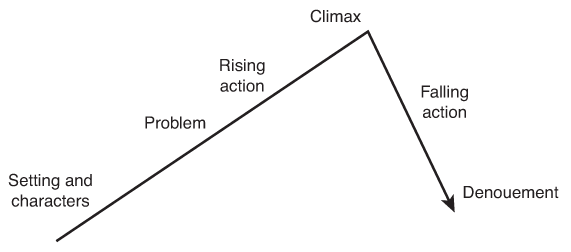
Pretty simple.
I learned this same chart through elementary, middle, and high school, so it's pretty much engraved in my skull at this point. But the only time we used it was on the big test we took after finishing whatever book we were supposed to be reading at the time. So, naturally, I didn't learn to appreciate how helpful this simple design can actually be.
I went through most of my (short) life thinking, That's just for summarizing books on tests and junk. I can't possibly use it in my own writing. ERRRR--wrong! (That's the noise a game show buzzer makes, by the way.)
I've mentioned before that I started out writing as a panster, but realized that method wasn't working for me. For a cripplingly disorganized person, I really crave structure and planning when it comes to my writing. (Maybe I subconsciously realize my cluttered lifestyle isn't working and want to save my writing from falling into the same pit or something like that.) Somewhere in my writing journey (about midways through OPHELIA, I think), I figured out I needed to learn to plot.
How do these two things relate to one another?
That chart is how I taught myself to plot.
Of course, I'm a hardcore plotter, so the chart is only step one. I mean, look at my plotting notebook for DARK WATER:

(All that stuff sticking out is about half the paper out of another notebook.)
I've filled this notebook with detailed outlines for EVERY scene. But it wouldn't have been possible (okay, I'm exaggerating. It wouldn't have been as easy...) without that chart. Thanks to that uber simple design, I knew all my major plot points ahead of time. It was just a matter of fleshing out the rest.
I'd show you the chart I made for DARK WATER, but y'know...that would ruin the story.
Annnnyway...
After I draw up a "plot pyramid" (as many of my teachers called it), I fill four or five pages with a more detailed, but still pretty loose summary. It's almost like a synopsis. ('Cept it's usually really badly-written.)
After that, I just can't stand it anymore and start writing. I usually get about two or three chapters in, then I start taking about an hour or two every night before I go to bed to write out a couple of those detailed outlines for the scenes that follow. This helps keep me from getting stuck (on the plot. That's not to say I never get stuck on wording and whatnot). That's actually how I know I'm inching toward the end of DARK WATER--I'm in the process of detailing the big climax scene in my notebook right now.
So, basically, my plotting method looks a little like this:
Step 1) Draw a basic "plot pyramid."
Step 2) Write a synopsis. It's okay if it's crappy. It's not your official synopsis.
Step 3) Get fed up with plotting and start writing.
Step 4) Realize plotting is still important and start outlining your next few scenes before you write them.
Are you a plotter or a panster?
HAPPY WRITING, LOVELIES!
I went through most of my (short) life thinking, That's just for summarizing books on tests and junk. I can't possibly use it in my own writing. ERRRR--wrong! (That's the noise a game show buzzer makes, by the way.)
I've mentioned before that I started out writing as a panster, but realized that method wasn't working for me. For a cripplingly disorganized person, I really crave structure and planning when it comes to my writing. (Maybe I subconsciously realize my cluttered lifestyle isn't working and want to save my writing from falling into the same pit or something like that.) Somewhere in my writing journey (about midways through OPHELIA, I think), I figured out I needed to learn to plot.
How do these two things relate to one another?
That chart is how I taught myself to plot.
Of course, I'm a hardcore plotter, so the chart is only step one. I mean, look at my plotting notebook for DARK WATER:

(All that stuff sticking out is about half the paper out of another notebook.)
I've filled this notebook with detailed outlines for EVERY scene. But it wouldn't have been possible (okay, I'm exaggerating. It wouldn't have been as easy...) without that chart. Thanks to that uber simple design, I knew all my major plot points ahead of time. It was just a matter of fleshing out the rest.
I'd show you the chart I made for DARK WATER, but y'know...that would ruin the story.
Annnnyway...
After I draw up a "plot pyramid" (as many of my teachers called it), I fill four or five pages with a more detailed, but still pretty loose summary. It's almost like a synopsis. ('Cept it's usually really badly-written.)
After that, I just can't stand it anymore and start writing. I usually get about two or three chapters in, then I start taking about an hour or two every night before I go to bed to write out a couple of those detailed outlines for the scenes that follow. This helps keep me from getting stuck (on the plot. That's not to say I never get stuck on wording and whatnot). That's actually how I know I'm inching toward the end of DARK WATER--I'm in the process of detailing the big climax scene in my notebook right now.
So, basically, my plotting method looks a little like this:
Step 1) Draw a basic "plot pyramid."
Step 2) Write a synopsis. It's okay if it's crappy. It's not your official synopsis.
Step 3) Get fed up with plotting and start writing.
Step 4) Realize plotting is still important and start outlining your next few scenes before you write them.
Are you a plotter or a panster?
HAPPY WRITING, LOVELIES!

Tidak ada komentar:
Posting Komentar